
Introduction
Artificial intelligence is not one model or one technique. It is a landscape of different ways to learn from data, each with its own assumptions, strengths, and costs. This handbook helps you locate an idea before studying its details.
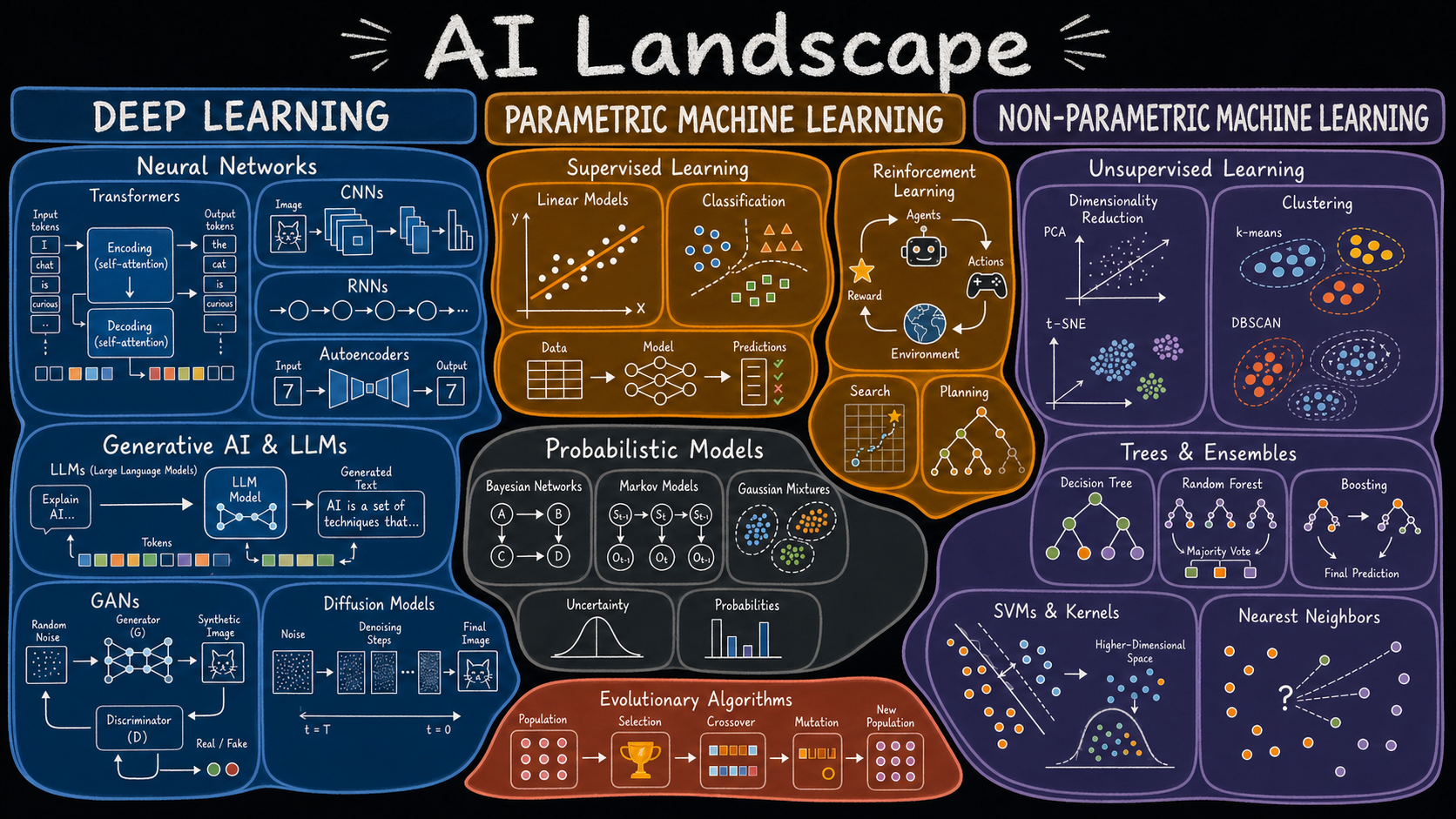
The map is an orientation tool, not a strict taxonomy. Some methods naturally belong to more than one region.
Four questions behind every learning system
Keep one common structure in mind:
Data → model → performance measure → minimization algorithm
| Part | Question |
|---|---|
| Data | What evidence is available at prediction time? |
| Model | What kind of rule can produce the prediction? |
| Performance measure | What does “better” mean for this problem? |
| Minimization algorithm | How is a better rule found? |
The model and the training algorithm are not the same thing. A model is the rule that produces a prediction. The algorithm is the procedure used to fit, select, or apply that rule.
How to use the handbook
- Follow the Course path for one clear learning sequence.
- Open Concepts when you need to understand an experimental idea.
- Use the Model atlas to compare architectures and algorithms.
Start with the path. Return to the map whenever you need to see how a new lesson fits into the larger field.